



 فارسی

Hematopoietic stem cell transplant failure: Lack of hematopoietic hematopoietic stem cells after transplantation (HSCT) is a complication that can occur during autologous and allogeneic stem cell transplantation. If the lack of hematopoiesis occurs during transplantation and before the patient is discharged from the hospital, the prognosis is not good.
Several factors are known to increase the risk of graft failure, and early risk reduction efforts are critical to minimize this tragic complication, as mortality associated with early graft failure remains high despite improvements in supportive care.
In the autologous stem cell transplantation settings, newer factors to increase stem cell motility and the detection of the minimum dose of stem cells required to proceed with this procedure have minimized the risks of transplant failure as much as possible.
However, in the allogeneic transplant setting, a combination of factors has made graft failure an ongoing concern. The incorporation of high-resolution HLA typing has reduced the risk of graft failure over the past decades. However, with the increasing use of non-myeloablative conditioning regimens and alternative transplant options, this complication remains a problem.
Optimal antibody testing of donors and recipients prior to transplantation, product and dose selection, and increased use of immunosuppressive agents as part of the conditioning regimen may minimize the risk of graft failure.
Furthermore, prompt identification of those at greatest risk for graft failure and prompt action to collect additional harvest provides the best chance of saving patients from the complications of prolonged and profound pancytopenia.
Autologous transplantation , Hematopoietic stem cell transplant failure
- Engraftment failure is defined as failure to achieve an absolute neutrophil count of 200/3mm on day 21+. Hematopoietic improvement may be transient, partial, or absent
- From an immunological point of view, graft rejection is not possible, but graft failure (non-graft) may still be seen.
- Engraftment failure may result:
– Injection of insufficient number of stem cells
– A damaged bone marrow microenvironment
– Concomitant infections, for example, CMV
– Freezing techniques that may damage stem cells
– Post-transplant medications, eg, trimethoprim/sulfamethoxazole or ganciclovir
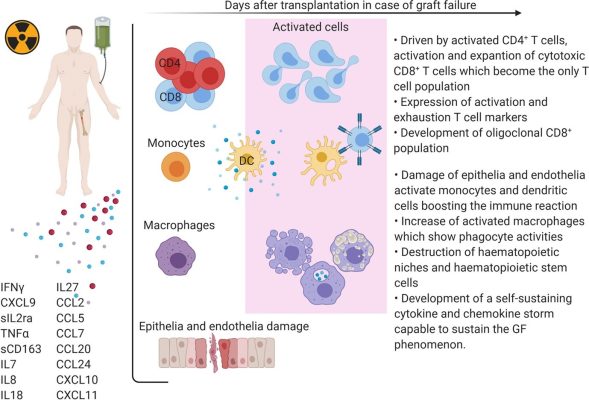
Allogeneic transplant
-
It is important to distinguish between graft failure and graft rejection:
– Primary graft failure is defined as complete graft failure (absolute neutrophil count less than 500/3mm with no evidence of relapse) on day 28+ after transplantation, regardless of stem cell source.
– Late graft failure is defined as the development of pancytopenia and bone marrow aplasia later after transplantation in the setting of prior establishment of donor-derived hematopoiesis.
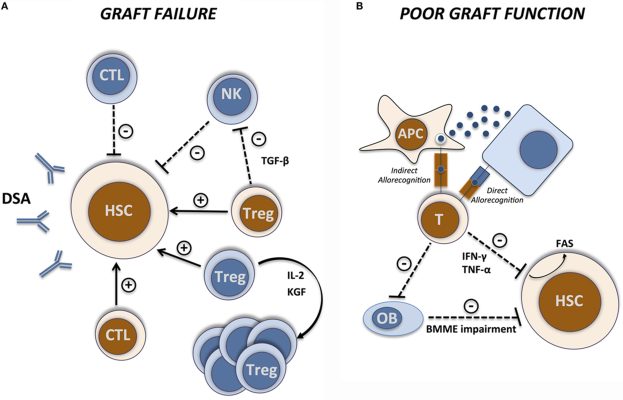
– Transplant rejection is best characterized over time by demonstrating donor chimerism that decreases in parallel with the development of peripheral cytopenias. This can best be controlled by following the donor lymphocyte. Persistence of host-derived cytotoxic T cells or NK cells or initiation of a GVHD reaction from donor cells may also lead to failure to maintain stem cell engraftment.
- 2. Pre-transplantation HLA antibody screening is a very useful tool to assess donor HLA-specific antibodies, which significantly increases the risk of graft failure, especially in partially matched or mismatched grafts.
– Determination of a positive panel reactive antibody (PRA) requires further investigation to determine HLA characteristics.
– Findings of specific HLA alloantibodies with a guide significantly increase the risk of graft failure and should be strongly considered in donor selection.
- Donor leukocyte infusion (DLI) is a frequent strategy for patients who relapse after allogeneic transplantation.
– DLI infusion(s) may result in a significant degree of cellular suppression and even aplasia. Aplasia is hypothesized to be due to T cells infused in the donor leukocyte product that recognize and destroy residual host brain cells.
– If the patient has severe chronic GvHD or at least residual donor cells are detected in chimerism studies before DLI, hematopoiesis may not recover without infusion of hematopoietic stem cells into the leukocyte donor product.
-
Risk factors for graft failure
– Transplantation with incompatible HLA
– Non-relative donor transplant – Umbilical cord blood donor transplant
– Aplastic anemia (especially, patients who have received many blood products before transplant)
– Fanconi anemia, thalassemia or immunodeficiency diagnosis
– Removal of T cells from hematopoietic stem cells in the cell collection product – Infections (especially CMV receptor positive) – Cell dose less than 0.2 x 10⁹/kg – Improper bone marrow microenvironment in diseases such as MDS and fibrosis
-
Diagnostic tests to check the failure or success of the transplant
– Peripheral blood cell count: Of note, previous studies have shown that a leukocyte count less than 200/μL on day 16+ after transplantation is a strong predictor of subsequent primary graft failure.
– Bone marrow aspiration and biopsy: In autologous and allogeneic patients, bone marrow studies show hypocellularity (decreased cell count) without detectable myeloid, erythroid, or megakaryocyte progenitor cells.
– FISH for sex chromosomes or cytogenetics of disease-specific double fusion products. For example, BCR/abl, and variable tandem repeats (VNTR) is a molecular diagnostic test used to determine posttransplantation/chimerism. These studies require blood storage (DNA purification) before transplantation from the donor and recipient. It is very useful in same-sex unions where FISH cannot be used for XX and XY.
– Testing for infectious diseases, especially CMV PCR, HHV6 PCR
-
Treatment
– The injection of hematopoietic growth factors (such as GM-CSF) following HSCT is especially effective for accelerating the recovery of neutrophils.
– Stem cell augmentation (± additional conditioning factors), i.e. cell/bone marrow support infusion, second transplant, etc. There are several case reports and studies showing successful transplantation after using fludarabine ± low-dose TBI (total body radiotherapy) regimens to inject more product.
– Suppression of the immune system, especially in the case of failed donor chimerism.
– Pharmacological investigation to eliminate mylotoxins (ganciclovir, ACE inhibitors, Bactrim, vancomycin, linezolid, H2 blockers, etc.).
– Eliminate infections
References
- Pierri F, Faraci M, Giardino S, Dufour C. Hematopoietic stem cell transplantation for classical
inherited bone marrow failure syndromes: an update. Expert Review of Hematology. 2021;14(10):911-25.
- Galgano L, Hutt D, Mekelenkamp H. HSCT: How does it work? The European Blood and Marrow Transplantation Textbook for Nurses: Under the Auspices of EBMT. 2023:25-43.
- Ozdemir ZN, Bozdağ SC. Graft failure after allogeneic hematopoietic stem cell
transplantation. Transfusion and apheresis science. 2018;57(2):163-7.
Authors and translators: Dr. Maryam Niconejad and Dr. Maryam Mehravar
Read other content:
Hodgkin’s lymphoma and non-Hodgkin’s lymphomas
References
