

Author Archives: بی ام تی

Chimerism

کایمریسم Chimerism

From a medical point of view, the word chimera is used to define an individual in which there is a population of cells from genetically different individuals. This phenomenon can occur spontaneously, such as embryo-to-embryo transfer or embryo-to-mother transfer, or artificially in the case of allogeneic hematopoietic stem cell transplantation  (HSCT).  The success of allogeneic […]

Calreticulin (calr) exon 9 mutation

جهش CALR

Calreticulin is a multifunctional soluble protein that plays a role in calcium homeostasis, it also binds to misfolded proteins and prevents their exit from the endoplasmic reticulum to the Golgi apparatus. The CALR mutation is acquired after birth and is not an inherited mutation. This disease is caused by the addition or deletion of small […]

Flow cytometry

فلوسایتومتری (Flow-cytometry) Peyvand Laboratory Bone marrow transplant laboratory

Flow-cytometry is a laboratory technology derived from the concept of cell measurement in fluid flow. This technique is based on laser, which is used to identify and check the physical and chemical properties of cells and particles. During the process, a sample of cells or particles is suspended in a liquid and injected into the […]

Hematopoietic stem cell transplant failure (GVHD)

Hematopoietic stem cell transplant failure (GVHD)

Allogeneic hematopoietic cell transplantation (allo-HCT) is a curative therapy for hematologic disorders, but its success is complicated by graft-versus-host disease (GvHD). Since allo-HSCT requires conditioning, tissue damaging events will occur in all patients undergoing this procedure. Chemotherapy and radiotherapy used during the conditioning regimens induce tissue damage and consequently release exogenous and endogenous molecules that […]

Organ failure following HSCT

Organ failure following HSCT

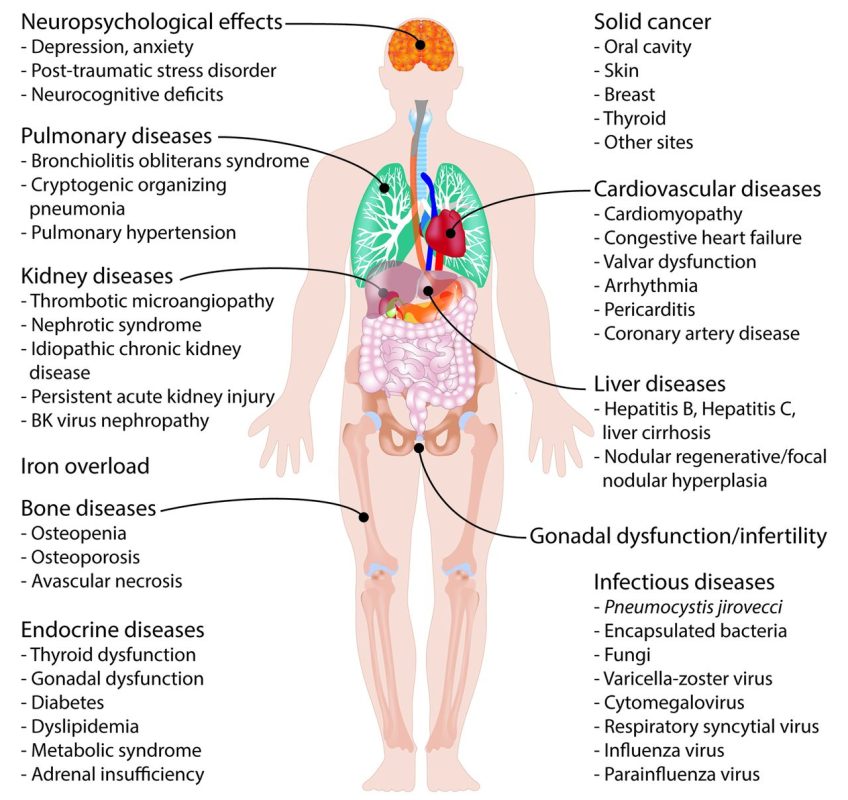
  In most cases, organ damage may occur following the administration of drugs used in chemotherapy and the preparation regimen for hematopoietic stem cell transplantation, total body radiotherapy (TBI), and chronic graft-versus-host disease (GVHD).    These injuries are temporary and reversible and in few cases can be life threatening. One study showed that the incidence […]

Infection

INFECTION

Infection is one of the common complications of patients undergoing hematopoietic stem cell transplantation (HSCT).The initial reconstruction of the immune system usually begins a few weeks after the transplantation of hematopoietic stem cells, but its complete reconstruction in terms of number and function requires months and even years. The innate immune system, such as neutrophils, […]

Hodgkin’s & Non-Hodgkin’s lymphoma

Hodgkin's lymphoma& Non-Hodgkin's lymphoma

Hodgkin’s lymphoma Hodgkin’s lymphoma is a type of cancer of the blood and immune system known as lymphoma, which may affect any part of the body’s lymphatic system, including the lymph nodes, bone marrow, or spleen. The most common age of its prevalence is in the third decade of life (20-24 years old) and after […]

Aplastic anemia

Aplastic anemia

Definitions Historically, the term “aplastic anemia” identifies a clinical entity where patients present with anemia and an empty marrow by bone marrow (BM) biopsy. Since 1885, when Paul Ehrlich described the first case in a pregnant woman, accumulating evidence has that this complication share several clinical, histological, molecular, and biological features, and that clinically and […]

Multiple Myeloma (MM)

multiple myeloma disease wallpaper مالتیپل میولما (MM)

Definitions of Multiple Myeloma (MM) Multiple myeloma is a hematologic malignancy characterized by presence of abnormal clonal plasma cells in the bone marrow, with potential for uncontrolled growth causing destructive bone lesions, kidney injury, anemia, and hypercalcemia. Multiple myeloma is diagnosed in an estimated 34 920 people in the US and in approximately 588 161 people worldwide […]